
Smartphone cameras have spent the last decade getting better through software. Optical image stabilization (OIS) counters small hand tremors with a physically floating lens element. Electronic image stabilization (EIS) crops and warps footage frame-by-frame to smooth out motion. Computational photography stacks dozens of exposures to fake a “cinematic” look, and AI processing cleans up noise, adjusts color, and tracks faces after the fact. All of these are clever, but they share one limitation: none of them can physically move the camera.
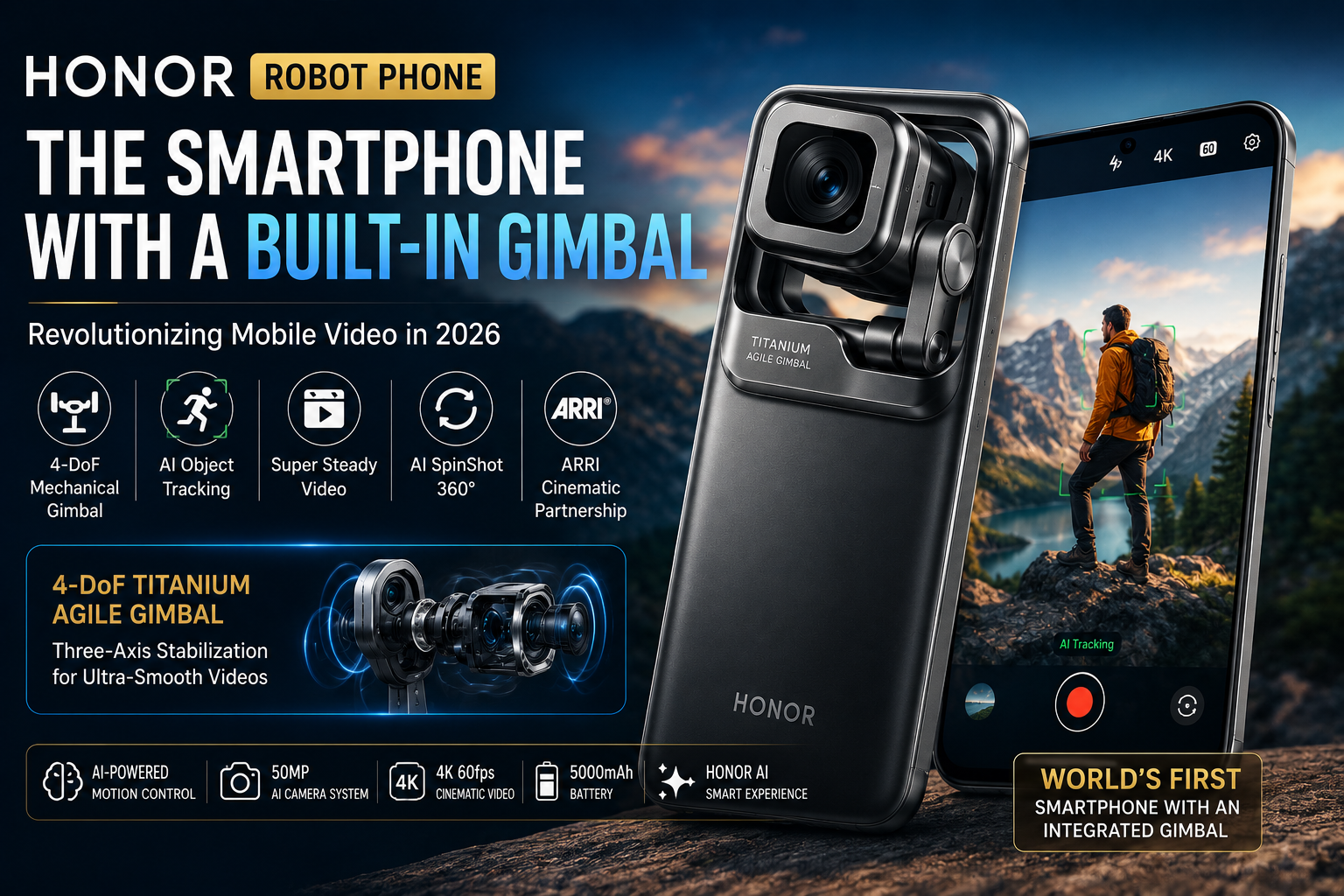
That is the premise behind the HONOR Robot Phone, a flagship Android device that HONOR officially launched in China on August 18, 2026, after previewing it at MWC 2026 and showing it off at events including the Cannes Film Festival and the Shanghai International Film Festival. Instead of relying only on software correction, the Robot Phone builds a genuine three-axis mechanical gimbal — HONOR calls it the Titanium Agile Gimbal — directly into the phone’s camera module. A small robotic arm, built from titanium alloy, pops out of the rear camera housing and physically pans, tilts, and rotates the main 200-megapixel camera while you shoot.
This matters most to a specific group of people: video creators, vloggers, travelers, and anyone who regularly shoots moving subjects one-handed. For a person taking the occasional vacation photo, a mechanical gimbal is a novelty. For someone who films while walking, running, or chasing a toddler around a living room, physical stabilization plus AI subject tracking can genuinely change what’s possible without carrying extra gear. This article explains what the HONOR Robot Phone actually is, how the gimbal works, what its camera and AI features do in practice, who should (and shouldn’t) consider it, and what we still don’t know as of its China launch.
A quick note on scope: as of this writing, the HONOR Robot Phone is sold officially only in mainland China. HONOR has said a global rollout is coming and has shown the device at international events such as WAIC 2026, but has not published official international pricing or release dates. Any global prices you see quoted elsewhere are typically currency conversions or third-party importer/reseller prices, not HONOR’s official international pricing.
What Is the HONOR Robot Phone?
The HONOR Robot Phone is a flagship Android smartphone built around one central idea: give the camera the ability to move on its own, the way a professional handheld gimbal rig does, without requiring the user to carry separate equipment. HONOR positions it as the top of its 2026 lineup — a device that sits alongside the Magic8 series but targets a different kind of buyer: content creators, mobile filmmakers, and people who post a lot of video rather than mostly still photos.
The “robot” branding is not just marketing flourish. It refers to two real things. First, the phone has an actual small motorized mechanical arm — the gimbal — that physically moves, similar in concept to a robotic limb. Second, HONOR has layered an AI assistant and interaction system, called YOYO, on top of that hardware. YOYO can recognize gestures, respond to voice commands, locate who is speaking in a room, and even give the gimbal small “personality” movements, like nodding or swaying to music, through what HONOR calls YOYO Robot Mode. In other words, “robot” describes both the physical movement of the camera arm and the AI layer that controls and reacts through it.
Strip away the personality features, though, and the core pitch is straightforward: HONOR wants to replace some of the reasons people buy a separate smartphone gimbal (like a DJI Osmo-style handle) by putting the stabilization hardware inside the phone itself.
The Built-In Gimbal: The Phone’s Biggest Feature
Most phones “stabilize” video two ways:
- OIS physically shifts a lens element (or the whole camera module) by a tiny amount to counteract small, fast hand shake. It cannot correct for large or sustained movement, like walking.
- EIS uses software to crop into the frame and digitally shift or warp footage to smooth motion after OIS has done its part. This can introduce a slight “jello” or overly smoothed look, and it costs some resolution/field of view because of the crop.
Neither OIS nor EIS involves the camera physically pointing itself somewhere new. That’s the gap HONOR is targeting with its Titanium Agile Gimbal, a mechanical system HONOR describes as a 4-DoF (four degrees of freedom), palm-sized robotic arm built from titanium alloy. According to HONOR and outlets that examined the hardware, the mechanism packs more than 100 precision components into a very small space, is manufactured across roughly 60 production steps, and is covered by more than 100 patents. HONOR says the arm achieves machining precision around 0.005mm with a rotation gap of about 0.4mm — figures aimed at showing how tightly toleranced the miniaturized mechanism is compared with a full-size external gimbal.
Independent hands-on coverage puts the gimbal’s moving motor assembly at roughly 2.6 grams and about 6mm thick, with HONOR describing it as roughly 65% smaller by volume than a DJI Osmo Pocket-style gimbal while claiming higher structural stability and torque density. It can rotate a full 360 degrees and, per HONOR, extends and becomes ready to shoot in well under a second.
The key distinction worth remembering:
- OIS = tiny lens-level correction for hand shake.
- EIS = software-level cropping/smoothing after the fact.
- Mechanical gimbal (Titanium Agile Gimbal) = the entire camera module physically pans, tilts, and rotates in real time, on a motorized arm, independent of how the phone body itself is held.
- AI tracking = software (YOYO, AI Object Tracking) that decides where the gimbal should point based on a recognized subject, gesture, or voice.
Notably, the Robot Phone still uses OIS on its main and telephoto lenses as a secondary layer of stabilization on top of the mechanical gimbal — it is not an either/or system. The gimbal handles large, sustained movement (walking, running, panning to follow someone); OIS and EIS still help smooth out the smaller, faster shake that a motorized arm isn’t built to chase.
How the Gimbal Actually Helps With Video
Walking and vlogging. When you walk while filming with a normal phone, each footstep sends a jolt through the frame that EIS has to crop and smooth away, usually at some cost to field of view and with occasional warping artifacts on fast movement. Because the Robot Phone’s camera is mounted on a physically moving arm, the gimbal can counteract that jolt directly, the same way a handheld external gimbal does, before software correction even needs to step in.
Following a moving person. This is where AI Object Tracking comes in. HONOR’s YOYO system can recognize a subject (a person, in most demonstrated use cases) and tell the gimbal to keep panning and tilting to hold that subject in frame automatically — useful for solo creators filming themselves walking, dancing, or doing an activity without a second person holding the camera.
Shooting one-handed. Because stabilization and some framing work is offloaded to the motorized arm rather than requiring two hands or a rig, the phone is designed to be usable one-handed for shots that would otherwise require a gimbal handle and a second hand to operate its buttons.
Cinematic camera movement. HONOR ships several automated movement modes: Tilt Lock (keeps the horizon level regardless of how the phone body tilts), First-Person View (FPV) and FPV Vertical modes, and AI SpinShot, which performs a rotational sweep around a subject while recording — the kind of move that would otherwise require a dedicated gimbal accessory and some practice to pull off smoothly.
Low-light video. It’s important to be realistic here: a mechanical gimbal solves motion blur caused by camera movement, not the fundamental physics of low light. In dim conditions, sensor size, aperture, and computational noise reduction (handled by HONOR’s self-developed Drive H1 imaging chip) still do the heavy lifting. The gimbal can help by keeping longer exposures steadier, but it doesn’t turn a dark room into daylight.
Travel videos. For travelers who don’t want to pack a separate stabilizer, having a gimbal built into the phone itself is the most straightforward selling point: one less item to carry, charge, and set up before getting a shot.
To be clear, the gimbal is not a universal substitute for a dedicated gimbal rig in every situation — see the external-gimbal comparison further down for where standalone hardware still has an edge.
AI Camera and Motion Features
Beyond the raw mechanical hardware, HONOR layers several named AI features on top of the gimbal:
- AI Object Tracking — recognizes and follows a subject, keeping them framed as they move.
- Super Steady Video — HONOR’s branding for the combined gimbal-plus-EIS stabilization pipeline during handheld recording.
- AI SpinShot — an automated rotational sweep move around a subject.
- Automated camera movement / gesture control — the gimbal can be triggered to move, extend, or reframe using hand gestures, without touching the screen.
- 90-degree and 360-degree rotation — the arm can pivot to reframe a shot from portrait to landscape-style angles, or fully spin.
- YOYO Robot Mode — adds voice interaction, sound-source localization (turning to face whoever is speaking), and expressive “personality” movements such as nodding or moving in time with music.
- YOYO Auto Execution — an AI-agent layer HONOR describes as able to handle certain multi-step tasks autonomously, with a developer interface for third-party integration.
Practically speaking, these fall into two buckets: features that directly affect how footage looks (tracking, SpinShot, stabilization) and features that are more about the phone’s AI-assistant/robot personality (dancing to music, gesture greetings). The former is squarely useful for creators; the latter is a differentiator aimed at making the phone feel distinctive, and its real-world usefulness will vary by user. It’s also worth noting that some YOYO features are currently more fully realized in the Chinese market, where the underlying AI services and app ecosystem are based.
HONOR and ARRI: What Does the Partnership Mean?
HONOR partnered with ARRI, the German cinema camera and lighting company whose equipment is used throughout professional film and TV production, on what both companies describe as a cinematic imaging collaboration. It’s important to be precise about what this does and doesn’t mean.
ARRI does not manufacture the Robot Phone or its camera hardware. What HONOR states is that the phone incorporates elements of ARRI’s color science and imaging pipeline: native ARRI LogC3 video encoding, support for the ARRI Wide Gamut 3 color space, and on-device LUT (look-up table) color grading through a dedicated Cinema Mode. LogC3 is a flat, low-contrast recording profile widely used in professional cinema cameras because it preserves more dynamic range for color grading later — the same logic HONOR is applying here so that footage from the Robot Phone can, in principle, slot into professional color-grading workflows more easily than typical smartphone video.
For readers, the realistic takeaway is this: the ARRI partnership is primarily a color-science and workflow collaboration, aimed at giving the Robot Phone’s video a more “graded,” professional-camera look and making its footage easier to intercut with real cinema camera footage in post-production. It is not a claim that the Robot Phone contains ARRI-manufactured camera hardware or that it matches the image quality of an actual ARRI cinema camera, which uses vastly larger sensors and lenses.
HONOR Robot Phone Camera System
Main camera (gimbal-mounted): 200MP, 1/1.28-inch sensor, f/1.6 aperture, roughly 23mm full-frame-equivalent focal length, OIS, mounted on the Titanium Agile Gimbal for physical stabilization.
Telephoto camera: 200MP, 1/1.4-inch sensor, f/2.6 aperture, roughly 62mm equivalent, OIS, offering approximately 2.7x optical zoom (reports mention digital zoom extending much further, up to roughly 200x, with the usual quality trade-offs that come with heavy digital zoom on any phone).
Ultrawide camera: 50MP sensor, f/2 aperture, roughly 10mm equivalent, about a 122-degree field of view. HONOR has not published a sensor size for this camera.
Front camera: 50MP.
Video: up to 4K recording, reportedly at up to 120fps on supported modes, processed through HONOR’s self-developed Drive H1 imaging chip, which also handles noise reduction in high-contrast and low-light scenes.
It’s worth distinguishing hardware from software here: the sensors, lenses, apertures, and the gimbal’s mechanical range are hardware. AI Object Tracking, Super Steady Video processing, AI SpinShot choreography, the LogC3/ARRI color pipeline’s LUT application, and YOYO’s gesture and voice recognition are software/AI layers running on top of that hardware. A phone with similar sensors but no AI processing would not replicate these shooting modes.
HONOR Robot Phone for Video Creators
YouTubers: The combination of 4K recording, LogC3/ARRI color workflow support, and AI-assisted stabilization can streamline both shooting and post-production color grading for long-form content, though full production pipelines will still often move footage to a computer for final editing.
TikTok and Instagram creators: AI SpinShot, automated tracking, and one-handed shooting are well-suited to short vertical video, where creators frequently film themselves without a second camera operator.
Travel vloggers: The strongest use case — walking shots, one-handed operation, and not having to pack a separate gimbal are direct, tangible benefits for people who film while moving through unfamiliar places.
Short-film and mobile filmmakers: The ARRI color pipeline and Cinema Mode are aimed squarely at this group, but a phone sensor is still a phone sensor; expect the Robot Phone to be a strong pre-production or B-roll tool rather than a full replacement for a dedicated cinema camera on serious productions.
Casual users: The gimbal is a genuine novelty and can be fun, but casual photographers who mostly shoot static images may not get enough day-to-day value from it to justify the added size, weight, and price over a conventional flagship.
HONOR Robot Phone vs a Traditional Smartphone
| Feature | HONOR Robot Phone | Traditional Flagship Smartphone |
|---|---|---|
| Mechanical camera movement | Yes — motorized 4-DoF arm | No |
| OIS | Yes, on main + telephoto | Usually yes, on main (and often telephoto) |
| Electronic stabilization | Yes, layered on top of gimbal | Yes, primary video stabilization method |
| AI subject tracking | Yes — YOYO / AI Object Tracking | Varies; many flagships offer some tracking-AF |
| Automated camera movement | Yes — Tilt Lock, FPV, SpinShot | No — framing changes require moving the phone |
| Physical gimbal system | Yes, built-in and retractable | No; requires external accessory |
| Video stabilization quality | Mechanical + electronic combined | Electronic (+ OIS) only |
| Creative camera movement | Built-in automated modes | Manual movement only, or third-party apps/rigs |
| Need for external gimbal | Reduced for many use cases | Often needed for smooth moving shots |
| Portability | Slightly thicker/heavier than average flagship | Typically slimmer and lighter |
| Ease of use | Learning curve for gimbal modes and YOYO features | Familiar, standard camera app |
Traditional flagship smartphones are not “unstabilized” — nearly all current flagships combine OIS and EIS effectively for handheld video. The Robot Phone’s differentiator is adding a physically moving camera on top of that existing stack, not introducing stabilization where none existed before.
Does a Built-In Gimbal Really Matter?
Where it matters:
- Walking or running while filming
- Following a moving subject (yourself or someone else)
- Tracking shots and reveals
- Creative transitions and rotational moves (SpinShot)
- One-handed shooting in dynamic situations
- Travel content where packing light matters
Where it matters less:
- Standard still photography
- Static landscape or architecture shots
- Portraits where the subject and camera are both stationary
- Tripod-mounted photography or video
- Casual social-media snapshots taken in a few seconds
The honest answer is that a mechanical gimbal is a specialized tool. It solves a real, specific problem — motion during handheld video — extremely well. For photography-first users, or anyone whose smartphone use is dominated by quick static photos, the gimbal adds size, weight, and cost without a proportional day-to-day benefit.
HONOR Robot Phone vs External Smartphone Gimbal
Advantages of the built-in system:
- Always with you — no separate accessory to remember, charge, or pack
- Faster setup — HONOR says the arm extends and is ready in under a second
- Better suited to spontaneous shooting, since there’s no attach/balance step required
- Tighter integration with the phone’s AI features (voice, gesture, subject recognition) since it’s all one system
Advantages of an external gimbal (e.g., a DJI Osmo-style handle):
- Larger stabilization hardware generally means a greater range of physical motion and heavier payload tolerance
- Dedicated physical controls (joystick, dial, trigger) rather than touchscreen or gesture control
- Broader accessory compatibility (mounts, filters, follow-focus attachments, extension poles)
- Can be paired with other cameras, not just one specific phone
- Often has a longer usable battery life dedicated purely to the gimbal motor, separate from the phone’s own battery drain
Balanced conclusion: for spontaneous, everyday moving shots, the built-in system removes friction that often means people simply don’t bother with a separate gimbal at all. For planned, professional shoots that need extended range of motion, dedicated physical controls, or multi-camera setups, a standalone gimbal still has real advantages. The two aren’t strictly competitive — many creators may still use both, depending on the shoot.
Design and Build
Fitting a motorized mechanical arm into a phone chassis without making it unusably bulky was one of HONOR’s central engineering challenges. According to specifications shared by HONOR and independent outlets:
- Thickness: reported at roughly 9.6mm (excluding the raised camera module), noticeably thicker than most current flagships, which typically sit closer to 7–8mm.
- Weight: reported at roughly 248 grams, heavier than most 6.3-inch flagship phones, a direct trade-off for housing the gimbal mechanism.
- Display protection: HONOR references “Giant Rhinoceros Glass” / NanoCrystal Shield-branded protective glass on the front panel.
- Body: a metal unibody design with a glass or faux-leather rear panel depending on color/finish, with colors reported at launch including Silver and Gray (earlier prototype showings referenced Black, White, and Gold finishes, so final retail colors should be confirmed against HONOR’s official product page for your market).
- Camera housing: the gimbal folds flush into a recessed compartment behind a protective cover on the rear camera island; users manually slide the cover open, then launch the gimbal via the camera app or the YOYO assistant, and the arm unfolds automatically.
- The gimbal mechanism itself uses a titanium alloy structure that HONOR says achieves high manufacturing precision to keep the moving parts reliable at such a small scale.
HONOR has not published long-term mechanical durability claims (such as a rated number of open/close or rotation cycles) in its official specifications, so readers evaluating long-term reliability should treat that as an open question pending independent long-term testing.
Performance and AI
The Robot Phone runs on Qualcomm’s Snapdragon 8 Elite Gen 5, built on a 3nm process, paired with 12GB or 16GB of LPDDR5X RAM and 512GB or 1TB of storage depending on configuration. This is a current-generation flagship chipset also used across other 2026 Android flagships, so day-to-day performance, gaming, and general multitasking should be in line with other Snapdragon 8 Elite Gen 5 devices — HONOR has not published independent third-party benchmark comparisons as part of its own official materials, so specific benchmark numbers should be sourced from independent testing outlets once broader reviews are available, rather than assumed.
Camera processing is handled by HONOR’s own Drive H1 imaging chip, which works alongside the Snapdragon platform specifically for tasks like noise reduction, subject tracking computation, and real-time gimbal-camera coordination (HONOR’s “gimbal AI zone audio” feature, for instance, syncs directional audio pickup with where the gimbal camera is currently pointed).
Because the phone combines a flagship chipset, an always-available AI assistant layer (YOYO / Agentic OS), and a motorized mechanical component, thermal management is a legitimate consideration — running the gimbal, 4K/120fps recording, and AI subject tracking simultaneously is a heavier combined workload than typical phone use. HONOR includes a custom cooling system in the device, though independent sustained-performance testing under heavy gimbal-plus-recording use had not been widely published at the time the phone launched.
Display
The HONOR Robot Phone uses a 6.31-inch LTPO OLED panel with a resolution reported at 2,640 x 1,216 pixels (roughly 1.5K), an adaptive refresh rate ranging from 1Hz to 120Hz, and a peak HDR brightness of up to 6,800 nits — a very high figure aimed at keeping the screen readable in direct outdoor sunlight, which matters for creators checking exposure and framing while filming outside. The panel supports 4320Hz high-frequency PWM dimming and HONOR’s Oasis Eye Comfort technology, which combines AI-based defocus effects with hardware-level low blue light filtering.
For anyone reviewing footage or checking framing on the go — a common task for vloggers and travel creators — a bright, high-refresh display genuinely helps confirm shots are properly exposed and steady before moving on, rather than discovering issues later on a larger screen.
Battery and Charging
The Robot Phone uses a 7,060mAh silicon-carbon battery (HONOR lists a typical capacity of 7,060mAh and a rated capacity of 6,880mAh), one of the larger batteries currently available in a flagship-class phone. It supports 120W wired SuperCharge and up to 50W wireless SuperCharge (the latter requires a separately sold HONOR wireless charger rated at 50W or higher; using a lower-wattage charger will simply charge more slowly).
HONOR has not published an official estimate of battery life specifically while using the gimbal continuously, and it’s reasonable to expect that active gimbal motor use, 4K/120fps recording, AI subject tracking, and high display brightness will each draw more power than idle use or basic photography — as is true of any phone running similarly demanding features. Readers planning long shooting sessions should treat the large battery capacity as a buffer against these combined demands rather than an assumption of all-day heavy video use on a single charge.
HONOR Robot Phone Software and AI
The phone ships on Android 16 with HONOR’s MagicOS 10 interface layer on top, plus what HONOR describes as “Agentic OS” — a next-generation AI and software architecture built on top of MagicOS to power YOYO and the phone’s broader AI-agent features.
Key software/AI elements:
- YOYO AI assistant — voice interaction, gesture recognition, and the personality-driven “Robot Mode” behaviors tied to the gimbal.
- AI Object Tracking and multimodal perception — the system is described as able to identify sounds, track motion, and maintain visual awareness of its surroundings, syncing gimbal movement with directional audio pickup.
- YOYO Auto Execution — an AI-agent layer intended to handle certain multi-step tasks, with a stated third-party developer interface.
- Cinema Mode / ARRI color tools — LogC3 recording, ARRI Wide Gamut 3 support, and on-device LUT grading.
An important caveat for global readers: independent hands-on coverage following the China launch noted that while the core gimbal hardware and camera features work regardless of region, a number of YOYO’s AI-assistant functions are currently more fully built out for the Chinese market and its associated app/service ecosystem. Anyone outside China planning to import the device should not assume every advertised AI feature will work identically, or that Google services will be available, since the China-market version is built around HONOR’s China software stack rather than Google Mobile Services. Availability of Google services will depend on the specific regional variant HONOR eventually ships internationally, which had not been detailed at the time of the China launch.
Who Should Buy the HONOR Robot Phone?
Best for mobile content creators: The combination of mechanical stabilization, AI tracking, and cinema-oriented color tools directly targets people producing regular video content and wanting fewer accessories.
Best for vloggers: Walking shots, one-handed operation, and automatic subject tracking solve real, everyday vlogging pain points.
Best for travelers: Reduces the case for packing a separate gimbal, which matters more the lighter you’re trying to travel.
Best for smartphone photography enthusiasts: The high-resolution triple-camera setup (200MP main, 200MP telephoto, 50MP ultrawide) is a strong photography package on its own, gimbal aside — though enthusiasts focused purely on stills may not need the gimbal specifically.
Best for casual users: Harder to justify. The gimbal is a genuine technical achievement, but casual users who mostly take quick photos or short clips may see limited day-to-day benefit relative to a standard flagship at a lower price and slimmer profile.
Best for professional filmmakers: Be realistic — this is a strong tool for B-roll, behind-the-scenes footage, pre-visualization, and run-and-gun documentary-style shooting where a phone’s portability is an asset. It is not a substitute for a dedicated cinema camera, larger sensors, interchangeable lenses, or the control that professional rigs offer on a fully planned production.
Who Should NOT Buy It?
- Users who rarely shoot video and mostly take still photos
- Users who prioritize the slimmest, lightest phone possible — the Robot Phone is noticeably thicker and heavier than typical flagships because of the gimbal hardware
- Users who already own a flagship they’re happy with and don’t have a specific video-stabilization need
- Users who primarily photograph static subjects (landscapes, products, documents) where a moving camera offers little benefit
- Users who need a full professional interchangeable-lens camera system — the Robot Phone is still, fundamentally, a smartphone camera
- Buyers outside China who need guaranteed full Google services and complete feature parity, given the uncertainty around the international release at the time of writing
HONOR Robot Phone Pros and Cons
Pros
- Genuinely novel integrated mechanical gimbal (Titanium Agile Gimbal), not just marketing language for standard OIS
- Strong AI subject-tracking and automated shooting modes (AI SpinShot, Tilt Lock, FPV modes)
- ARRI color-science partnership brings LogC3 and professional color workflow support to a phone
- High-resolution triple-camera hardware (200MP main and telephoto, 50MP ultrawide)
- Large 7,060mAh battery with fast 120W wired and 50W wireless charging
- Very bright, high-refresh display well suited to reviewing footage outdoors
- Reduces the practical need to carry a separate external gimbal for many everyday scenarios
Cons
- Mechanical complexity is inherently a long-term reliability unknown; no official cycle-durability rating has been published
- Noticeably thicker (~9.6mm) and heavier (~248g) than typical flagship phones
- Price premium over a comparable non-gimbal flagship
- China-only official availability at launch, with global pricing and release timing unconfirmed
- Some YOYO AI-assistant features are more fully realized in the Chinese market/app ecosystem than they may be internationally
- Not a replacement for dedicated professional cinema camera equipment on serious productions
- Learning curve to make full use of gimbal shooting modes and gesture/voice controls
HONOR Robot Phone Price and Availability in 2026
HONOR opened pre-orders in China on August 12, 2026, with sales beginning August 18, 2026.
Official China pricing:
- 12GB RAM / 512GB storage: ¥9,999 (approximately $1,375–$1,480 USD at exchange rates reported around launch; conversions fluctuate)
- 16GB RAM / 1TB storage: ¥12,999 (approximately $1,790 USD)
These are official prices in the Chinese domestic market only. They are not official global prices, and currency conversions shown here are approximate, for reference, and will move with exchange rates.
As of the China launch, HONOR had not announced official international pricing or a release date, though the company has signaled a global rollout is planned and showcased the device at international events, including WAIC 2026. Some third-party importers and gray-market retailers have listed the Robot Phone for international shipping at marked-up prices — reported around $1,999 through at least one such retailer — but these are third-party reseller prices, not HONOR’s official international pricing, and buying this way typically means a China-region software build, potential lack of official warranty support outside China, and no guarantee of full Google services.
If you are outside China, treat any specific price or ship date you see for your country as unconfirmed until HONOR publishes it through an official regional HONOR store or newsroom announcement for your market.
Is the HONOR Robot Phone Worth It in 2026?
Is the gimbal genuinely useful? Yes, for the specific job it’s built for: stabilizing and reframing handheld video during movement. It is not a gimmick in the sense that it does real, physical work no other phone on the market currently does.
Is it better than normal OIS/EIS? For moving shots, yes — mechanical movement solves a category of motion that software correction alone struggles with. For small hand-shake correction on largely static shots, OIS/EIS on a well-implemented conventional flagship is already very capable, and the gimbal adds comparatively less there.
Does it replace a dedicated gimbal? Partially. It removes the need for a separate accessory in many everyday and travel scenarios, but a full-size external gimbal still offers more range of motion, dedicated physical controls, and accessory flexibility for planned, professional shoots.
Is it worth paying more for? That depends entirely on how much video you shoot and how often you’re moving while you shoot it. For frequent video creators, the price premium buys back the cost and hassle of a separate gimbal. For primarily-photo users, it’s a harder case to make.
Who gets the most value from it? Vloggers, travel creators, and anyone who regularly films themselves or moving subjects one-handed. Casual users and dedicated still photographers will likely find a conventional flagship a better value match for their actual usage.
HONOR Robot Phone vs the Competition
Rather than inventing direct spec-for-spec comparisons with specific rival phones, it’s more useful to place the Robot Phone within the broader 2026 smartphone camera landscape:
- Flagship camera phones from other major Android and iOS manufacturers continue to rely on increasingly sophisticated computational photography, larger sensors, and refined EIS/OIS combinations — but none currently ship a mechanical, motorized camera gimbal built into the phone body the way the Robot Phone does.
- Phones marketed around “strong OIS” or “pro camera” branding are generally competing on sensor size, aperture, and computational processing rather than physical camera movement.
- Phones with advanced AI subject tracking (for autofocus or framing suggestions) exist across the market, but typically direct the user to reposition the phone themselves, rather than physically moving the camera for them.
- Phones paired with external gimbals remain the closest functional comparison — the Robot Phone is essentially trying to internalize what that accessory category does.
The Robot Phone’s clearest differentiator in 2026 is not raw camera resolution (several flagships now ship 200MP sensors) — it’s the mechanical, physically moving camera system, which is not something resolution or software alone replicates. Whether that differentiator is worth the added size, weight, and price is a personal calculation based on how much moving-subject video a buyer actually shoots.
2026 Smartphone Camera Trends
The Robot Phone arrives at a moment when several trends are converging in mobile photography and video:
- Computational photography continues to mature, with multi-frame stacking, AI-assisted exposure blending, and scene recognition now standard on most flagships.
- AI camera systems increasingly handle subject recognition, auto-framing suggestions, and real-time noise reduction.
- Mechanical stabilization, as seen here, represents a new frontier beyond purely computational or optical approaches.
- Subject tracking is expanding from simple autofocus tracking toward full framing and camera-movement tracking, as demonstrated by the Robot Phone’s AI Object Tracking.
- Cinematic smartphone video is a growing category, with more brands pursuing LOG recording profiles, wider color gamuts, and professional-workflow compatibility (as with the ARRI partnership here).
- Larger sensors and periscope telephoto cameras continue to push image quality, evident in the Robot Phone’s dual 200MP main and telephoto sensors.
- Creator-focused smartphones, designed explicitly around content creation workflows rather than general-purpose use, are becoming a more distinct sub-category, with the Robot Phone as one of the most literal examples yet.
The HONOR Robot Phone fits squarely into this shift: it’s less an incremental camera upgrade and more a demonstration of where physical hardware innovation might go next, once purely computational and optical approaches start showing diminishing returns.
Frequently Asked Questions
What is the HONOR Robot Phone?
It’s a flagship Android smartphone, launched by HONOR in China in August 2026, built around a built-in mechanical camera gimbal called the Titanium Agile Gimbal, alongside flagship-level specs and an AI assistant system called YOYO.
Does the HONOR Robot Phone have a built-in gimbal?
Yes. A titanium-alloy, motorized three-axis (4-DoF) mechanical gimbal folds out from the rear camera housing and physically pans, tilts, and rotates the main camera during shooting.
How does the HONOR Robot Phone gimbal work?
A small motor assembly, reported at roughly 2.6 grams, drives the arm’s movement, allowing it to rotate up to 360 degrees and respond in real time to AI subject tracking, gesture commands, or preset shooting modes like Tilt Lock and AI SpinShot.
Is the HONOR Robot Phone good for video?
For handheld and moving-subject video, yes — the mechanical gimbal plus AI tracking directly addresses common video-shooting challenges like walking shake and one-handed framing, on top of a capable 200MP main camera and 4K recording support.
Can the HONOR Robot Phone track a moving person?
Yes, through its AI Object Tracking feature, which recognizes a subject and moves the gimbal to keep them framed.
What is AI SpinShot on the HONOR Robot Phone?
It’s an automated shooting mode where the gimbal performs a rotational sweep around a subject while recording, a movement that would typically require manual gimbal operation or a dedicated accessory.
Does the HONOR Robot Phone replace a smartphone gimbal?
Partially. It reduces the need for a separate external gimbal in many everyday and travel scenarios, but a full-size external gimbal still offers greater range of motion and dedicated physical controls for more demanding, planned shoots.
Does the HONOR Robot Phone use OIS?
Yes. The main and telephoto cameras both use OIS in addition to the mechanical gimbal, which handles larger, sustained movement that OIS alone is not designed to correct.
What is the HONOR and ARRI partnership?
HONOR collaborated with cinema camera company ARRI to bring elements of ARRI’s color science to the phone, including native LogC3 video recording, ARRI Wide Gamut 3 color space support, and on-device LUT color grading through a Cinema Mode. ARRI does not manufacture the phone’s camera hardware.
Is the HONOR Robot Phone available globally?
Not officially, as of its August 2026 launch — it is sold officially only in mainland China. HONOR has indicated a global rollout is planned but had not published international pricing or release dates at launch. Some third-party importers offer international shipping at a markup, without official warranty support in most other regions.
How much does the HONOR Robot Phone cost?
In China, official pricing starts at ¥9,999 (roughly $1,375–$1,480 USD depending on exchange rates) for the 12GB/512GB model, rising to ¥12,999 (roughly $1,790 USD) for the 16GB/1TB model. No official international price has been announced.
Is the HONOR Robot Phone worth buying in 2026?
It depends heavily on use case. For frequent video creators, vloggers, and travelers who shoot a lot of moving handheld footage, the built-in gimbal and AI tracking offer real, practical value. For users who mostly take still photos or prioritize a slim, light phone, a conventional flagship is likely a better fit.
Final Verdict
The HONOR Robot Phone matters because it pushes smartphone camera stabilization past the point where purely optical and electronic approaches were headed, by putting genuine mechanical movement inside the phone itself. That’s a meaningfully different engineering approach than another year of incremental sensor or software upgrades, and HONOR has clearly invested serious engineering effort into making a 4-DoF titanium gimbal small enough to fit in a phone at all.
If you frequently shoot video, track moving subjects, vlog, travel light, or want creative camera movement without carrying a separate gimbal, the technology here is genuinely interesting and, in several respects, unmatched by any other phone currently on the market.
For users who mainly take ordinary photos, the built-in gimbal should not automatically outweigh the other factors that make a phone good day-to-day: camera image quality in typical use, battery life, display quality, general performance, software support, and — not least — price and whether the device is even officially available and supported in your region. As of publication, that last point is a real, practical limitation: the Robot Phone remains a China-market device, with its international future still to be confirmed by HONOR.