
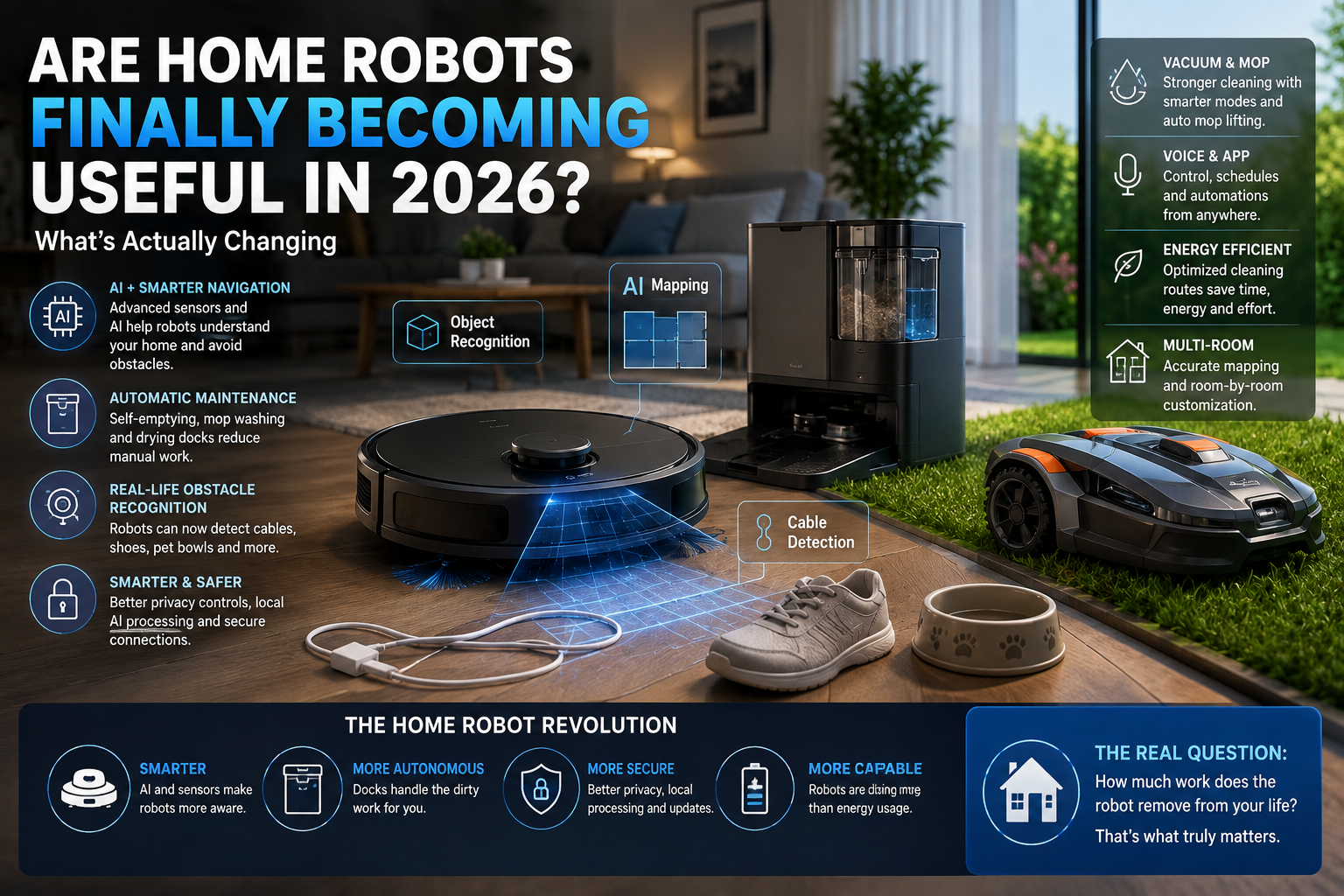
For most of their existence, robot vacuums followed a simple script: move around, bump into things, vacuum whatever’s underneath, and eventually find their way back to a charging dock. That was the whole job. Progress mostly meant slightly better maps and slightly fewer times the robot got stuck under the couch.
That script has changed. Walk through the announcements from CES 2026 in Las Vegas and IFA 2026 in Berlin, and it’s clear manufacturers are no longer just selling “a vacuum that moves itself.” They’re selling systems that try to recognize objects, understand rooms rather than just map them, avoid cables and clutter, mop with heated or steam-cleaned water, wash and dry their own mop pads, empty their own dustbins, and in some of the most ambitious cases, climb stairs or reach out and physically move small objects out of their way.
Whether that adds up to household robots finally becoming useful — as opposed to household robots simply becoming more expensive and more impressive on a spec sheet — is a genuinely open question. This article looks at what’s actually changing in 2026, what’s real versus what’s still a prototype on a trade-show floor, and how to think about whether an AI-powered home robot is actually worth buying for your specific home.
1. Robot Vacuums Are Becoming More Like Home Robots
The clearest trend of 2026 is that the product category itself is shifting. “Robot vacuum” is increasingly too narrow a description for what companies like Roborock, Ecovacs, Dreame, and Eufy are now building and marketing as broader home robotics platforms.
Older robot vacuums
- Basic pathing, often bouncing off obstacles rather than genuinely understanding the room
- Simple infrared or bump sensors with limited awareness of what they’d actually hit
- Frequent human intervention — untangling cables, freeing a stuck robot, emptying the bin
- Limited or no ability to distinguish between different types of obstacles
- Manual maintenance: washing the mop pad, cleaning the brush, refilling water by hand
Newer systems
- AI and computer vision layered on top of, or instead of, basic bump sensors
- More advanced simultaneous mapping, often building persistent, multi-floor maps of a home
- Attempts at object recognition, not just object detection
- Improved (though still imperfect) obstacle avoidance around real household clutter
- Increasingly automated maintenance handled at the dock rather than by hand
- Better handling of multi-room homes, including navigating between floors in some flagship models
It’s worth being direct about one thing: not every premium feature works flawlessly in every home. A feature that performs well in a controlled demo — clean hardwood floors, good lighting, tidy staging — doesn’t automatically perform the same way in a cluttered real-world living room with patterned rugs, dim lighting, and a toddler’s toys scattered across the floor. Reviewers and independent testers have repeatedly found that marketing demonstrations and real-world performance can diverge, which is exactly why this article treats “AI-powered” claims with some healthy skepticism rather than taking them at face value.
2. AI Is Changing How Robots Understand Your Home
The more interesting shift in 2026 isn’t just better sensors — it’s a change in what robots are attempting to do with what they sense.
For years, “obstacle avoidance” simply meant: something is in front of me, stop or steer around it. That’s still the baseline for budget robots. What’s changing at the higher end is a move toward something closer to semantic understanding — attempting to identify what an object actually is, and deciding how to respond based on that identification, rather than treating every obstacle identically.
Simple obstacle avoidance asks: Is there something here?
Semantic or object recognition asks: What is this specific thing, and how should I behave around it?
In practice, that distinction is meant to look something like this: instead of treating a phone charging cable, a sock, and a table leg all the same way, a more advanced robot vacuum equipped with AI-based vision might attempt to identify the cable specifically and route around it, while still cleaning right up to a fixed piece of furniture. Manufacturers at CES 2026 showcased systems designed to recognize categories like shoes, cables, pet waste, and small toys, and several brands have highlighted improved detection of liquids and spills as a specific area of focus.
It’s important not to overstate where this technology actually is. Object recognition in consumer robotics is meaningfully better than it was a few years ago, but it is not infallible. Independent reviewers continue to find real-world gaps between marketed capabilities and consistent performance, particularly in cluttered rooms, dim lighting, unusual objects the AI wasn’t trained to recognize, and homes with dark-colored carpets that challenge some sensor types. Think of today’s semantic recognition as a genuine improvement layered on top of imperfect obstacle avoidance — not a solved problem.
3. The Docking Station Is Becoming a Mini Robot Base
If there’s one area where 2026’s home robots have made an unambiguous leap forward, it’s the dock.
Docking stations used to do one job: recharge the battery. Increasingly, they’ve become small automated maintenance hubs in their own right. Depending on the model, a modern dock may now handle:
- Automatic dust emptying from the robot’s onboard bin into a larger, less frequently emptied container
- Washing the mop pad with clean water after each cleaning cycle
- Drying the mop pad (sometimes with heated air) to prevent mildew and odors between uses
- Refilling the robot’s onboard water tank automatically
- Self-cleaning cycles for the dock’s own internal components
- Broader maintenance automation intended to reduce how often an owner needs to touch the machine at all
This matters more than it might initially sound. The actual value proposition of a home robot was never purely “how well does it clean” — plenty of manual vacuums and mops clean perfectly well. The real value proposition is how little ongoing effort the owner has to put in to keep the system running well over time. A robot that cleans excellently but requires you to manually wash a grimy mop pad every other day isn’t saving you nearly as much effort as one that handles that step itself. The most meaningful 2026 upgrades tend to live at the dock, not on the robot itself.
4. Robot Vacuums Are Learning to Deal With Real-Life Mess
Trade-show floors are, by design, close to ideal environments: even lighting, clean surfaces, and staged rooms. Real homes are not that. They involve loose cables snaking behind furniture, single socks that seem to appear out of nowhere, scattered kids’ toys, pet food bowls, furniture with thin legs, uneven thresholds between rooms, stairs, general clutter, and the occasional wet or sticky patch on the floor.
This gap between demo conditions and daily reality is exactly why obstacle avoidance remains one of the single most important areas of ongoing improvement in home robotics — arguably more important, for everyday usefulness, than raw suction power or mapping speed. A robot with excellent suction that repeatedly gets tangled in cables or knocks over a lightweight side table isn’t actually saving its owner time; it’s creating a new category of chores.
It would be inaccurate, though, to claim that any current robot can reliably avoid every kind of object in every home. Coverage of CES 2026 and IFA 2026 shows manufacturers explicitly targeting these real-world failure points — better cable detection, improved handling of thresholds and uneven flooring, and even MOVA’s tactile “skin” concept, which uses pressure sensors to physically feel when it’s touched something unexpected rather than relying purely on cameras. These are genuine attempts to close the gap between demo and reality, but they remain works in progress rather than solved problems.
5. Robot Mops Are Becoming More Advanced
Mopping has arguably seen more meaningful innovation in 2026 than vacuuming itself. The category has moved through several distinct stages:
- Basic combination units that dragged a barely-damp pad behind the vacuum, offering minimal actual cleaning
- Vacuum-and-mop combos with automatic mop washing at the dock, removing one of the most unpleasant manual maintenance tasks
- Heated and steam-based cleaning, which several 2026 launches — including new models from Roborock and Tineco — use to help dissolve sticky spills and grime that cold water simply pushes around
- Improved edge cleaning, often using extending or rotating mop heads to reach corners and baseboards that older square pads missed
- Automatic carpet detection and mop lifting, so the robot raises its mop pad when it senses carpet instead of soaking it
- Multiple cleaning modes, letting owners choose lighter maintenance cleans versus deeper, slower passes for heavily soiled floors
Robot mopping is genuinely useful for routine maintenance cleaning on hard floors — keeping kitchens, entryways, and bathrooms from accumulating everyday grime between more thorough manual cleans. It is generally not a replacement for deep, scrubbing-level cleaning of heavily stained or very sticky floors, and most robot mops still struggle with high-pile carpets, thick rugs, and truly stubborn dried-on messes. Think of it as automated upkeep rather than a substitute for occasional manual deep cleaning.
6. Robot Lawn Mowers Are Expanding Beyond Simple Automation
Indoor cleaning robots aren’t the only category evolving quickly. Robotic lawn mowers, historically a smaller and more niche market than robot vacuums, saw a notable wave of announcements at both CES and IFA 2026, from brands including Roborock, Ecovacs, and MOVA.
The biggest shift in mower technology mirrors what’s happening indoors: a move away from older, more rigid systems and toward AI-assisted, sensor-rich navigation. Relevant technologies now include:
- GPS and GNSS positioning for outdoor mapping and location tracking
- Camera-based perception, used alongside or instead of traditional sensors
- AI-based navigation intended to help the mower understand lawn boundaries and obstacles more intelligently
- Boundary-wire-free operation, letting some newer models map and navigate a yard without the buried perimeter wire that older robotic mowers required
- Obstacle detection, aimed at avoiding garden furniture, hoses, pets, and irregular terrain
- Mapping, often paired with companion apps for scheduling and zone control
- Automatic charging, returning to a base station when the battery runs low, similar to indoor robot vacuums
Who should consider one: Homeowners with a reasonably sized, relatively open lawn who want to remove routine mowing from their weekly chore list are the clearest fit, particularly given that several new 2026 models claim to handle moderate slopes and irregular boundaries without a buried wire.
Who should probably wait: Owners of very small, oddly-shaped, or heavily obstructed yards, renters who can’t install fixed infrastructure, and anyone in a region where local regulations, HOA rules, or noise ordinances restrict autonomous outdoor equipment should factor those constraints in before buying. Availability, certification, and even legality of some autonomous outdoor robots can vary meaningfully between the US, the UK, and other markets, so it’s worth confirming a specific model is actually approved and sold in your country before assuming it will work exactly as advertised.
7. Could Robots Eventually Do More Than Cleaning?
Some of the most attention-grabbing news out of CES and IFA 2026 wasn’t about cleaning performance at all — it was about robots starting to physically manipulate the world around them.
MOVA, for instance, unveiled concepts including a robotic-armed lawn mower (branded AstraX) designed to notice an obstacle, physically move it out of the way, and continue mowing, alongside a “tactile skin” concept for vacuums that uses pressure sensors to physically feel obstacles rather than relying purely on cameras. Dreame showed a robot vacuum concept incorporating a small retractable claw intended to grab and relocate small objects, like a stray sock, out of its path. Separately, some manufacturers used their 2026 keynotes to preview companion-style robots — Ecovacs, for example, introduced a small AI-driven companion robot alongside its cleaning lineup.
It’s essential to draw a clear line here between three very different things:
- Available products: robot vacuums, mops, and lawn mowers with automated docks and AI-assisted navigation that you can currently buy or that have confirmed release dates in the US or UK.
- Announced but not yet widely available: products revealed at trade shows with a stated launch window, sometimes region-specific, that haven’t yet reached general retail.
- Early-stage concepts and prototypes: technologies like robotic arms on mowers, tactile skin systems, or claw-equipped vacuums that were demonstrated on a show floor but are not yet shipping consumer products, and may never reach the market in their demonstrated form.
None of the manipulation-focused concepts described above are products you can currently buy for general household use. They represent a direction the industry is exploring — robots that don’t just sense their environment but physically act on it — rather than a capability already sitting in stores. Treat any specific claims about robotic arms, claws, or advanced manipulation as forward-looking research and development, not as features you can purchase today.
8. The Biggest Problem: Price
However capable these systems become, cost remains the central obstacle to widespread adoption — and it’s worth understanding what that money actually buys, category by category, rather than focusing on specific figures that will be outdated within months.
Budget robots trade cost for simplicity. Expect fewer sensors, more basic (often bump-and-sensor) navigation rather than full mapping, little or no automated maintenance, and more manual involvement from the owner — emptying the bin, washing the mop pad, and periodically untangling the robot by hand.
Mid-range robots aim for a practical balance: reasonably capable mapping (often LiDAR-based), moderate obstacle avoidance, functional mopping, and at least some automated maintenance features, without the most advanced AI vision systems or fully hands-off docks.
Premium robots push further on every axis — more sensors, more sophisticated AI-based object recognition, more fully automated docking stations (self-emptying, mop washing, mop drying, water refilling), and increasingly ambitious extras like stair navigation or steam mopping. That additional capability comes with a real trade-off beyond the sticker price: more complex hardware generally means more components that can eventually need repair or replacement, and some premium features may depend on ongoing app support, firmware updates, or in a few cases subscription-based services to keep working as intended.
Because pricing for specific 2026 models varies by region, retailer, and ongoing promotions — and because several flagship models announced at CES and IFA 2026 hadn’t confirmed final US or UK pricing at launch — this article intentionally avoids quoting specific dollar or pound figures. Check current, region-specific pricing directly from retailers and manufacturers before making a purchase decision.
9. Privacy: Your Robot May Know More About Your Home Than You Think
This is one of the most important — and most overlooked — considerations when buying a modern home robot.
To do its job well, a capable robot vacuum needs to build a detailed picture of your home: room layouts, furniture positions, doorways, and often the location of things like stairs or beds. Many models add cameras for navigation and obstacle avoidance, and some support two-way audio or live video streaming for remote home-monitoring features. Depending on the model and your settings, this can include:
- Floor plans and room layouts, built and stored by the robot’s mapping software
- Camera images, used for navigation and object recognition, and in some cases accessible via a companion app
- Cleaning schedules and usage patterns, which reveal when people are typically home or away
- Device and network information, including Wi-Fi details needed to connect the robot to your home network
Where and how this data is handled varies significantly between manufacturers and models, and it’s a meaningful factor to research before buying, not after:
- Cloud vs. local processing: some systems process mapping and image data primarily on the device itself, while others send data to manufacturer servers for processing or storage. Locally processed data generally leaves your network less often, which reduces (though doesn’t eliminate) certain risks.
- Camera privacy controls: look for the ability to disable the camera, set “no-go” or “no-map” zones, and control whether and when live video streaming is available.
- Account security: features like two-factor authentication on the companion app add meaningful protection against unauthorized access.
- Encryption: data transmitted between the robot, the app, and any cloud servers should be encrypted in transit and ideally at rest.
- Data retention policies: check how long a manufacturer keeps map and image data, and whether you can request deletion.
- Privacy policies: these documents, while often dense, spell out exactly what’s collected and how it may be used or shared — including whether data may be used to train future AI models.
Security researchers have documented real vulnerabilities in connected home devices, including robot vacuums, in past years — underscoring that these aren’t purely theoretical concerns. This isn’t a reason to single out any one company, since security and privacy practices differ meaningfully across the industry and change over time as firmware updates are released; it’s a reason to actually read the privacy and security documentation for a specific model before bringing an internet-connected, camera-equipped, mapping robot into your home, rather than assuming all brands handle data the same way.
10. Do You Actually Need an AI Robot?
Not every home benefits equally from a modern AI-powered robot, and that’s a genuinely useful thing to figure out before spending money on one.
Good reasons to buy
- You run a busy household with limited time for regular manual cleaning
- You have pets that shed regularly, and want more consistent daily maintenance
- You have large, relatively open floor space that benefits from automated, scheduled coverage
- You clean frequently already and want to offload the routine, repetitive parts of it
- You’re specifically drawn to the convenience of automation and are comfortable managing a connected device
- You struggle physically with manual vacuuming or mopping and want to reduce that burden
Reasons to wait
- You live in a small apartment where manual cleaning already takes only a few minutes
- Your home is currently quite cluttered, which will likely lead to more interventions and frustration regardless of how advanced the robot’s AI is
- Your budget is tight, and a mid-range or premium robot would strain it for marginal benefit over your current setup
- Your existing vacuum or cleaning routine already works well for you
- You’re uncomfortable with the idea of a camera-equipped, mapping device moving through your home
- You’re not interested in maintaining another connected device — firmware updates, app permissions, and occasional troubleshooting included
11. What Should You Look For When Buying a Home Robot?
If you’ve decided a home robot makes sense for you, use this checklist to evaluate specific models rather than relying on marketing headlines alone.
Navigation
- LiDAR-based mapping vs. camera-based (vSLAM) navigation, or a hybrid combining both
- How the system builds and saves maps across multiple rooms or floors
Obstacle avoidance
- Whether the model specifically claims object recognition, not just basic obstacle detection
- Documented performance on small-object detection (cables, socks, small toys) in independent reviews, not just manufacturer claims
Cleaning performance
- Suction power and how it’s adjusted automatically for different floor types
- Brush design, particularly for pet hair-prone homes
- Mop system type: pad-based, roller-based, and whether it includes automatic washing
- Edge and corner cleaning performance
Automation
- Self-emptying dust collection
- Automatic mop washing and drying at the dock
- Automatic water tank refilling
- How much manual maintenance is genuinely required day-to-day versus what’s automated
Smart features
- Companion app quality, including scheduling and room/zone selection
- Voice assistant compatibility, if that matters to your setup
- Smart home ecosystem compatibility (for example, Matter support)
Privacy
- Camera on/off controls and no-go zone settings
- Local vs. cloud data processing options
- Manufacturer’s track record on security updates and firmware support
Long-term maintenance
- Availability and cost of replacement parts: filters, brushes, mop pads, and batteries
- How long the manufacturer typically supports a given model with software updates
12. Are Expensive Robot Vacuums Actually Worth It?
Rather than comparing specific prices, it’s more useful to compare what you’re actually trading off across the price tiers.
| $ Budget | $$ Mid-Range | $$$ Premium | |
|---|---|---|---|
| Automation | Minimal; mostly manual maintenance | Some automated maintenance features | Extensive automation, often near hands-off |
| Navigation | Basic sensors, limited mapping | Solid LiDAR or camera-based mapping | Advanced sensor fusion, multi-floor mapping |
| Cleaning | Adequate on simple, open floor plans | Good general-purpose performance | Strongest suction, mopping, and adaptability |
| Obstacle avoidance | Basic bump-and-detect | Improved detection of common obstacles | AI-based recognition, best real-world handling |
| Convenience | More owner involvement required | Balanced; less frequent intervention | Closest to fully hands-off operation |
| Privacy considerations | Fewer cameras/sensors, generally simpler data footprint | Varies significantly by model | Often camera-equipped; requires closer privacy review |
| Long-term ownership | Lower repair complexity, simpler to replace | Reasonable balance of cost and complexity | Higher potential repair costs, more complex hardware |
The takeaway is straightforward: the most expensive robot on the market is not automatically the best choice for every home. A premium model with advanced AI object recognition is wasted on a small, tidy apartment where a mid-range robot would perform just as well in practice. Conversely, a large, cluttered home with pets may genuinely benefit from premium-tier obstacle avoidance and automated maintenance, where a budget model would require constant intervention. Match the tier to your actual home and habits, not to the most impressive spec sheet.
The Real Question Isn’t “How Smart Is the Robot?”
It’s tempting to evaluate home robots the way you’d evaluate a smartphone — more sensors, more AI, more features, better. But that framing misses the point of what these devices are actually for.
The better question is this: How much work does the robot actually remove from my life?
That reframing changes which factors actually matter:
- Intervention required: How often do you realistically need to step in — freeing a stuck robot, untangling a cable, manually restarting a cycle?
- Cleaning consistency: Does it reliably do a good job on a normal, lived-in floor, not just a staged demo room?
- Maintenance burden: How much of the upkeep (emptying, washing, refilling) is genuinely automated versus something you still have to do by hand?
- Reliability over time: Does performance hold up after months of use, or does navigation quality degrade as sensors get dusty or software goes unsupported?
- Obstacle handling in your specific home: Not in a demo, but with your actual cables, rugs, pets, and clutter.
- Navigation and software quality: Are map updates and companion-app improvements ongoing, or has the manufacturer moved on to newer models?
- Availability of replacement parts: Can you actually get a new filter, brush, or battery two or three years from now?
- Privacy: Are you comfortable with what the device knows about your home and how that information is handled?
- Total ownership cost: Not just the purchase price, but replacement parts, potential repairs, and any subscription costs over the robot’s realistic lifespan.
A robot that scores well on marketing spec sheets but poorly on these day-to-day, lived-in measures isn’t actually solving the problem it was bought to solve. A genuinely “smart” robot, by this standard, is one that quietly and reliably removes a chore from your life — not one that simply has the most sensors.
The Future of Home Robots
Based on the direction shown at CES and IFA 2026, several trends are worth watching — with the clear caveat that these are reasonable predictions based on current research and prototypes, not guaranteed outcomes.
- Better object manipulation: Early concepts like robotic arms on mowers and claw-equipped vacuums suggest a longer-term shift toward robots that can physically interact with objects, not just avoid them.
- More capable robotic arms: If manipulation technology matures and becomes reliable and affordable, it could eventually extend into more general household assistance tasks.
- Improved object recognition: AI vision systems are likely to keep improving at distinguishing between different types of clutter and household items, though likely incrementally rather than as a sudden leap.
- Better home navigation: Expect continued refinement of multi-floor mapping, threshold handling, and navigation in cluttered or irregular spaces.
- Multi-purpose robots: The current trend of a single company offering vacuums, mops, lawn mowers, pool cleaners, and window cleaners suggests growing interest in a more unified home robotics ecosystem rather than isolated single-purpose devices.
- Deeper smart-home integration: Continued adoption of standards like Matter could make home robots interact more seamlessly with other connected devices.
- More on-device (local) AI processing: As chips capable of running AI models locally become cheaper, expect more processing to happen on the robot itself rather than in the cloud, which could also help address some privacy concerns.
- Autonomous household tasks beyond cleaning: Concepts like companion robots and object manipulation point toward a longer-term ambition of robots taking on a wider range of household tasks — but this remains a multi-year (or longer) trajectory, not something arriving in the immediate future.
None of this is guaranteed. Consumer robotics has a long history of ambitious concepts that never made it to market in their demonstrated form, and the gap between a trade-show prototype and a reliable, affordable consumer product is often much larger than it appears on stage.
Pros and Cons
Pros
- Genuine convenience for routine, repetitive cleaning tasks
- Increasing automation of unpleasant maintenance steps (mop washing, bin emptying)
- More consistent cleaning schedules than many people maintain manually
- Reduced physical effort, which matters for some households more than others
- Meaningfully improved navigation compared to earlier generations
- Continued, rapid iteration suggests further improvement is likely, not a dead end
Cons
- Meaningful upfront cost, particularly for the most capable models
- Real privacy considerations that require active research before buying
- Ongoing maintenance, even on “automated” systems, especially over the long term
- Dependence on manufacturer software and app support for full functionality
- Batteries and some components will eventually need replacement
- More complex hardware generally means more that can potentially go wrong
- Some advanced features may be tied to app ecosystems or, in limited cases, subscriptions
- Even the best current robots can still struggle in genuinely messy or unusual environments
FAQ
Are home robots actually useful in 2026? For many households, yes — particularly for routine floor maintenance in reasonably tidy, open homes. They’re more capable than earlier generations, though they still aren’t flawless, and usefulness depends heavily on your specific home layout and habits.
Are robot vacuums getting smarter? Yes, in a meaningful sense. Newer models increasingly use AI-based computer vision for navigation and obstacle handling, rather than relying purely on basic bump sensors, and CES and IFA 2026 both showed continued investment in this direction.
Can robot vacuums recognize objects? Some premium models attempt object recognition — identifying specific items like cables, shoes, or pet waste rather than treating every obstacle the same way. This technology is improving but is not perfectly reliable in every environment.
Are AI robot vacuums worth the money? It depends on your home and habits. Larger, busier households with pets often see clear value from premium features; smaller or already-tidy homes may get similar practical results from a mid-range model.
Do robot vacuums need cameras? No. Many models use LiDAR or other sensors for navigation without a camera. Cameras add object-recognition capability but also introduce additional privacy considerations worth weighing.
Are robot vacuums safe for pets? Generally yes for cleaning purposes, and many 2026 models specifically market improved pet-hair handling and pet-waste avoidance. That said, no robot’s obstacle avoidance is guaranteed to be perfect, so supervising early use with a new pet in the home is a sensible precaution.
What is the difference between a cheap and expensive robot vacuum? Broadly: navigation sophistication, the reliability of obstacle avoidance, how much maintenance is automated at the dock, and additional features like mopping, self-emptying, and AI-based object recognition. Higher price generally buys more automation and more consistent real-world performance, though with more complex hardware.
Are robot lawn mowers worth buying? For homeowners with a reasonably sized, relatively open lawn who want to remove routine mowing from their schedule, yes. Availability of boundary-wire-free models and specific features varies by region, so check local availability and any relevant regulations first.
Do robot vacuums collect personal data? Many do, including floor maps, usage patterns, and in some cases camera images. How that data is stored and used varies significantly by manufacturer and model — check the specific privacy policy before buying.
Will home robots eventually do more than vacuum? That appears to be the direction the industry is heading, based on 2026 concepts involving robotic arms, object manipulation, and companion robots. However, these remain early-stage concepts and prototypes rather than available consumer products today.
Sources to Verify
Because this article covers current 2026 product announcements, verify specific claims, pricing, and availability against these types of sources before publishing or updating:
- Official CES 2026 and IFA 2026 exhibitor announcements and press materials
- Official manufacturer websites and product documentation, including Roborock, Ecovacs, Dreame, Eufy/Anker, iRobot, Samsung, Tineco, MOVA, and other major home robotics brands
- Reputable independent technology publications with hands-on CES 2026 and IFA 2026 coverage
- Independent consumer testing and review publications for real-world performance claims
- Manufacturer privacy policies and security documentation for specific models
- Regional regulatory bodies for autonomous outdoor equipment rules where applicable, including HOA or local ordinance guidance in the US, and relevant UK product safety and data protection guidance