
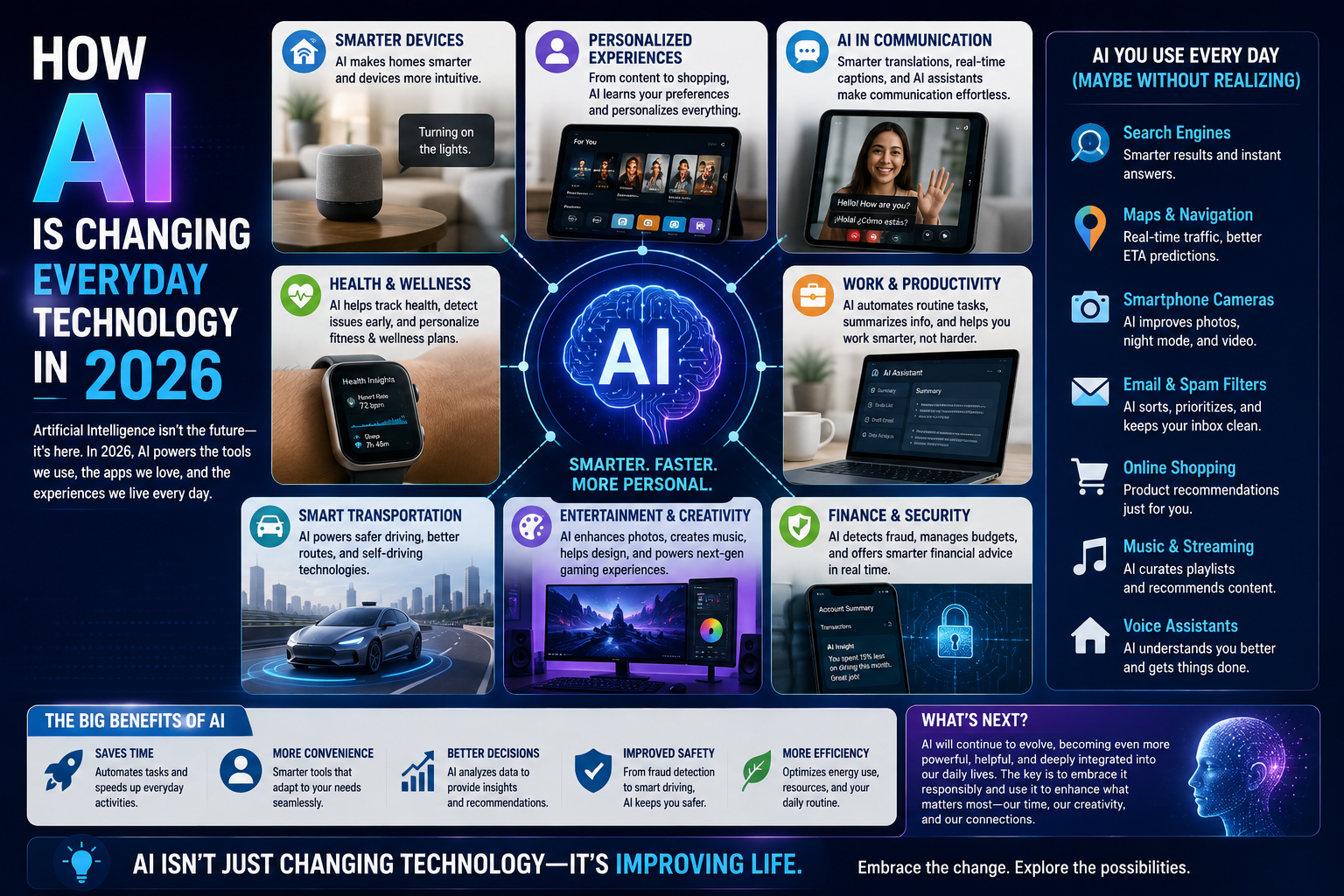
Artificial intelligence has shifted from a specialized, experimental technology into a foundational layer embedded within modern consumer electronics. Today, AI technology quietly powers the devices we use daily, including smartphones, laptops, search engines, cameras, smart home hubs, and productivity software. Rather than standing alone as a distinct gadget category, artificial intelligence functions as an invisible engine designed to optimize performance, automate repetitive tasks, and assist with complex workflows.
However, the rapid spread of AI integration has also introduced a wave of marketing terminology. Manufacturers frequently label products as “AI-powered,” making it difficult for consumers to separate genuine utility from promotional hype. To make informed purchasing decisions, buyers need to understand what these features actually do, how they affect day-to-day use, and where their limitations lie.
For a broader look at how modern computing trends intersect with daily software, explore our [Internal Link: AI & Tech] and [Internal Link: Tech Explained].
1. What Does AI Actually Mean?
To understand how artificial intelligence shapes consumer hardware, it helps to strip away the marketing jargon. At its core, AI refers to computer systems designed to perform tasks that traditionally required human intelligence, such as recognizing speech, identifying objects in images, translating languages, and generating text.
Several foundational concepts drive modern consumer technology:
- Machine learning: A subset of AI where systems analyze data and improve performance over time without being explicitly reprogrammed for every new scenario.
- Generative AI: Models capable of creating new text, images, or audio based on user prompts.
- AI assistants: Software tools designed to interpret natural language commands and execute actions or provide answers.
- Computer vision: The ability of software and hardware to interpret visual data from cameras or sensors.
- Natural language processing (NLP): Technologies that allow computers to understand, interpret, and generate human language.
These concepts form the backbone of the features built into everyday devices.
2. AI in Smartphones
Smartphones represent the most ubiquitous platform for artificial intelligence. Because mobile devices travel with us everywhere, manufacturers utilize AI to enhance responsiveness, photography, and battery management.
In mobile photography, AI algorithms process image data milliseconds after a shutter click to reduce noise, balance lighting, sharpen details, and recognize subjects. Voice assistants have grown more conversational, allowing users to issue complex multi-step commands. On-device translation tools enable real-time text and voice conversion without requiring a persistent internet connection. Furthermore, modern mobile operating systems utilize machine learning to predict user habits, optimize charging patterns to preserve battery health, and dynamically manage background app refreshing.
For further exploration of mobile technology advancements, visit our [Internal Link: Phones].
3. AI on Computers and Laptops
Laptops and desktop computers leverage artificial intelligence to streamline heavy workloads and professional workflows. AI tools integrated into operating systems and standalone applications assist with text drafting, summarizing lengthy documents, generating images, and transcribing video meetings into structured notes.
A critical distinction in modern computing is where this processing occurs. Cloud-based AI sends data to remote data centers for heavy computation, enabling advanced capabilities that require massive server resources. Conversely, on-device AI processes data locally using specialized hardware inside the computer. On-device processing offers enhanced privacy and operates without an internet connection, though it may be limited by local hardware capacity.
To learn more about selecting capable hardware for modern computing loads, check out our [Internal Link: Laptops] and [Internal Link: PC Hardware].
4. AI in Search and Online Services
Online search engines and digital services have fundamentally transformed through the integration of conversational AI. Instead of merely returning a list of blue links, search platforms now synthesize answers from multiple sources, offering direct summaries and contextual follow-up capabilities.
E-commerce platforms, streaming services, and productivity tools also rely on machine learning algorithms to refine product recommendations, tailor customer support via automated chat agents, and surface relevant content. However, because AI-driven search models generate conversational responses rather than static links, users must verify important factual information instead of automatically trusting generated answers.
5. AI in Cameras and Photography
While optical quality, lens design, and sensor size remain the primary drivers of photographic excellence, artificial intelligence plays an increasingly vital role in image capture and post-processing.
AI-driven scene recognition automatically adjusts exposure settings based on whether the camera detects a landscape, a portrait, or a fast-moving subject. Computational photography algorithms reduce low-light grain, synthesize realistic background blur for portrait effects, and automatically organize massive photo libraries by recognizing faces, locations, and objects. While these features make it easier to capture striking photos, they complement rather than replace foundational photography principles like composition and lighting.
6. AI in Smart Home Technology
Smart home ecosystems utilize machine learning to transition from simple remote-controlled gadgets into proactive, automated environments. Smart speakers interpret natural language more accurately, reducing frustration caused by rigid voice commands.
Security cameras use computer vision to differentiate between routine motion—such as passing pets or swaying tree branches—and actual security events, significantly reducing false alerts. Smart thermostats analyze household routines, weather forecasts, and insulation properties to optimize indoor climate control and reduce energy waste. While these automated conveniences improve home efficiency, they also require careful attention to privacy settings and data security policies.
For more insights into connected home ecosystems, explore our [Internal Link: Smart Home].
7. AI for Everyday Productivity
For students, office workers, and creators, artificial intelligence serves as a versatile digital assistant. Productivity applications incorporate AI to summarize long email threads, organize chaotic notes, brainstorm outlines, translate documents, and streamline scheduling conflicts.
Accessibility features also benefit significantly from machine learning. Real-time speech-to-text transcription, live captioning, and automated image descriptions empower users with visual or hearing impairments to interact with digital content more fluidly. However, users should treat AI output as a drafting aid rather than an infallible authority, carefully reviewing all generated work before publication or submission.
8. AI in Gaming
The video game industry integrates artificial intelligence across both player experiences and game development pipelines. On the hardware and software side, AI-driven rendering technologies upscale lower-resolution graphics to high-definition clarity while maintaining smooth frame rates.
Inside games, machine learning helps govern non-player character (NPC) behaviors, creating more dynamic interactions. Developers also utilize AI tools to accelerate asset generation, assist with code debugging, and conduct automated game testing during production.
For ongoing discussions on gaming hardware and performance optimization, visit our [Internal Link: Gaming].
9. AI Hardware
As artificial intelligence features become standard, hardware manufacturers have integrated specialized processing units into modern silicon chips.
- NPUs (Neural Processing Units): Microchips specifically engineered to handle machine learning tasks efficiently without draining system battery life.
- GPUs (Graphics Processing Units): Originally designed for rendering visuals, modern GPUs excel at the parallel processing required for complex AI workloads.
- CPUs (Central Processing Units): The main processor handling general system instructions and coordinating hardware tasks.
While dedicated AI hardware improves local processing efficiency, hardware specifications alone do not guarantee a superior user experience. Useful software integration, long-term update support, and practical feature design matter just as much as raw processing capability.
10. Benefits of AI in Everyday Technology
When implemented thoughtfully, artificial intelligence provides several tangible benefits for everyday consumers:
- Saving time: Automating tedious tasks like transcription, formatting, and file sorting.
- Automation: Streamlining multi-step smart home routines and system adjustments.
- Accessibility: Enhancing communication tools for users with diverse physical needs.
- Personalization: Tailoring software interfaces and recommendations to individual preferences.
- Productivity: Providing instant summaries and research outlines to accelerate workflows.
- Creativity: Offering flexible brainstorming and editing tools for digital creators.
- Convenience: Delivering faster, more conversational interactions with digital services.
11. Limitations and Risks
A balanced evaluation of consumer AI requires acknowledging its current limitations and potential risks. AI models can occasionally produce inaccurate information, “hallucinating” facts with absolute confidence.
Privacy concerns also arise when cloud-based models process personal data, documents, or search histories. Furthermore, machine learning models can reflect inherent biases present in their training data, and the proliferation of AI-generated misinformation requires users to maintain a critical eye toward digital media. Avoiding over-reliance on automated tools ensures that human judgment remains central to important decision-making.
12. Should You Buy a Device Because It Has AI?
With manufacturers heavily promoting artificial intelligence across every product line, consumers face a crucial question: should AI features drive a purchasing decision?
The short answer is no. “AI-powered” should never be the sole reason to purchase a device. Consumers should evaluate products based on traditional, fundamental metrics:
- Overall performance and processing speed
- Battery life and energy efficiency
- Software update longevity and support policies
- Physical build quality and ergonomics
- Hardware and software compatibility
- Price relative to overall value
- Features you will actually utilize in your daily routine
If an AI tool genuinely solves a problem in your workflow, it represents a valuable bonus. If it is merely a marketing buzzword for a task you rarely perform, it should not influence your investment.
13. How to Use AI More Responsibly
As AI tools become integrated into daily life, adopting responsible habits helps protect personal privacy and ensure accurate outcomes:
- Verify important information: Cross-reference AI-generated facts with reliable primary sources.
- Protect sensitive data: Avoid inputting confidential financial records, private identification numbers, or personal documents into public AI tools.
- Check generated content: Carefully review emails, code, and documents drafted by AI before sharing them.
- Review privacy settings: Examine device and software permissions to control what data is shared or stored.
- Keep software updated: Ensure operating systems and applications receive regular security patches.
- Maintain perspective: Treat AI as a helpful assistant rather than an unquestionable authority.
14. Future of AI in Consumer Technology
Looking ahead, consumer technology will likely see continued, measured integration of machine learning rather than sudden sci-fi leaps. Reasonable expectations for future development include more capable on-device processing that preserves user privacy, deeper personalization across operating systems, and more seamless cross-device synchronization.
Smart home systems will likely become more context-aware, anticipating household needs without requiring constant manual programming. Similarly, creative and productivity tools will continue refining their interfaces to reduce friction between human intent and digital execution.
15. AI Technology Checklist
Before purchasing an AI-powered device or subscribing to an AI service, run through this practical evaluation checklist:
- What does the AI feature actually accomplish for your daily routine?
- Does the feature operate locally on the device or require cloud processing?
- Does the service require a persistent internet connection to function?
- What specific data does the feature collect or analyze?
- Can the AI functionality be disabled if desired?
- Is the feature genuinely useful, or is it a superficial marketing addition?
- Does the product provide strong overall value relative to its price?
- How many years of software and security support will the device receive?
Comparison Table
| AI Application | What It Does | Main Benefit | Important Consideration |
| Smartphones | Enhances photos, optimizes battery, translates text | Everyday convenience and better mobile utility | Processing varies by device model |
| Computers | Summarizes notes, assists writing, speeds up editing | Accelerated professional productivity | Cloud vs. local processing differences |
| Search | Synthesizes web answers and conversational results | Faster information discovery | Requires fact-checking for accuracy |
| Photography | Recognizes scenes, reduces noise, sharpens details | Cleaner, more balanced images | Does not replace fundamental photography skills |
| Smart Home | Automates routines, filters false security alerts | Energy savings and peace of mind | Privacy and data collection policies |
| Gaming | Upscales resolution, optimizes frame delivery | Smoother visual performance | Hardware requirements vary |
| Productivity | Drafts text, organizes schedules, transcribes speech | Time savings on administrative work | Output requires human review |
| Accessibility | Provides live captions and speech-to-text conversion | Greater digital inclusion | Accuracy depends on audio/visual clarity |
FAQ
- Q: Do I need an internet connection to use AI features on my phone?
- A: It depends on the feature. Simple tasks like photo organization or basic battery optimization often run locally on-device, while complex generative tasks typically require cloud connectivity.
- Q: Will AI tools replace human creativity?
- A: AI functions as a drafting and assistive tool. While it accelerates execution, human intent, emotion, and critical oversight remain essential for genuine creative work.
- Q: Are on-device AI features more secure than cloud-based AI?
- A: Generally yes, because data processed locally on your hardware does not leave your device, minimizing third-party data collection risks.
- Q: Why are manufacturers adding dedicated NPUs to computers?
- A: NPUs handle machine learning tasks with high energy efficiency, freeing up the CPU and GPU for other system operations and preserving battery life.
- Q: Can I turn off AI features if I do not want to use them?
- A: Most modern operating systems allow users to disable specific smart suggestions, cloud assistants, or automated background data processing within settings.
- Q: Should I upgrade my current device just to get AI features?
- A: If your current device meets your performance needs, upgrading solely for marketing-driven AI features is rarely necessary.
- Q: How can I tell if an AI-generated answer is correct?
- A: Always verify critical data—such as medical, financial, or historical facts—against trusted primary sources and official documentation.
Conclusion
Artificial intelligence has firmly established itself as a core component of modern consumer technology. From optimizing smartphone cameras and streamlining computer workflows to making smart homes more intuitive, AI offers genuine practical utility when applied thoughtfully.
However, consumers should approach AI integration with a balanced perspective. Rather than buying products swayed solely by “AI-powered” marketing labels, buyers should evaluate devices based on traditional benchmarks of performance, build quality, battery life, and everyday usefulness. By treating AI as a capable digital assistant and keeping human judgment at the center of technology use, consumers can navigate the evolving digital landscape with confidence.
MIT Technology Review – An authoritative overview of the ten AI trends, technologies, and research directions shaping the field in 2026, from a publication known for rigorous, non-hype technology journalism. Click here to open the article.
USA Today – Coverage from CES 2026 explaining how AI is being built into everyday products people already own — TVs, PCs, smartphones, and cars — rather than only appearing in standalone novelty gadgets. Click here to open the article.
Built In – A trend-focused piece on how generative AI moved from novelty to daily utility in 2026, covering areas like transportation, shopping, and home management. Click here to open the article.